
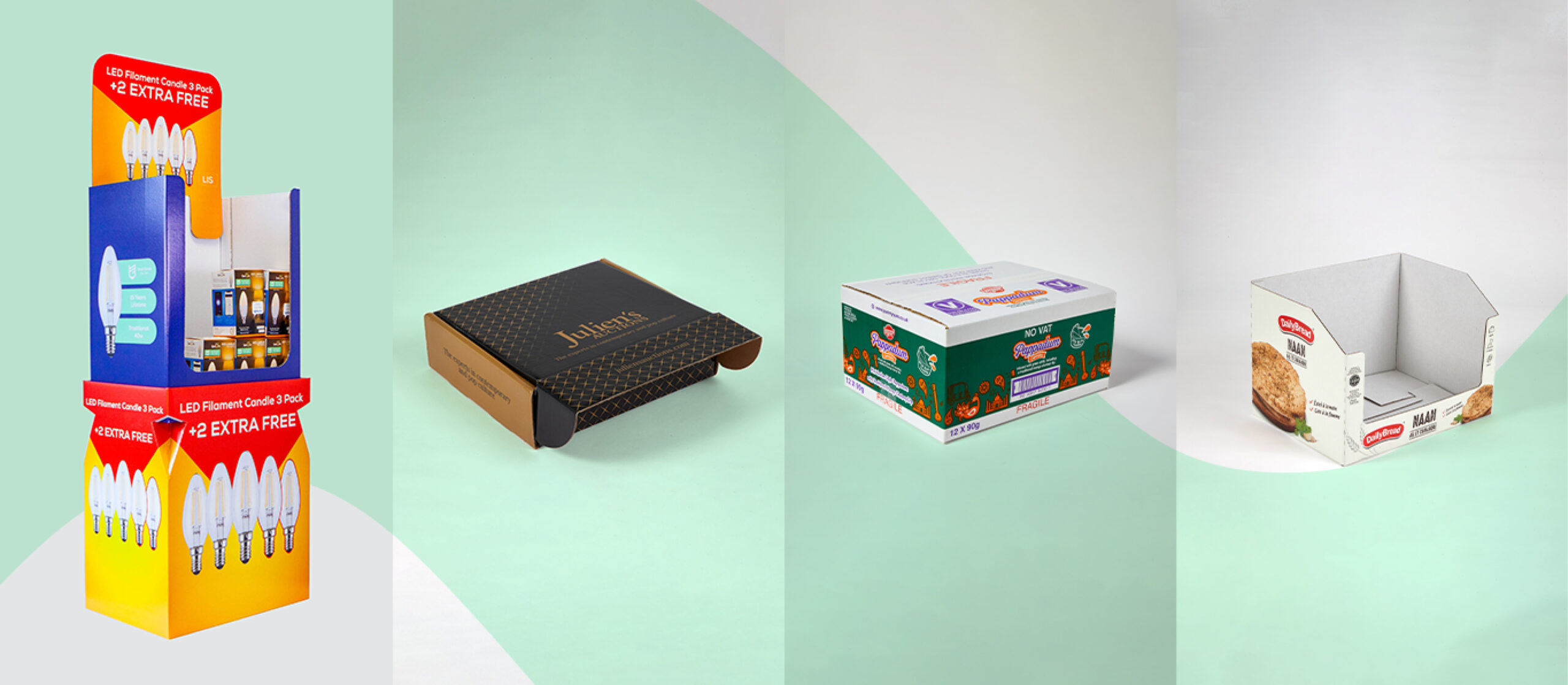
Corrugated packaging plays a critical role in branding, customer experience, retail presentation, and supply chain efficiency.
From bold retail displays to simple transit packaging, the print process used on corrugated packaging can significantly impact both appearance and performance.
Understanding the variety of print methods available helps businesses choose the right solution based on budget, design complexity, production volume, and application. Printing on corrugated board also requires specialised techniques because of the material surface. Flute size, board thickness, ink absorption, and production speed all influence print quality. So, which print process should you choose for your next project? Let’s find out!
Flexographic printing is the most widely used print process for corrugated packaging. It uses flexible rubber or photopolymer plates mounted on rotating cylinders to transfer ink directly onto the board surface.
Flexographic printing offers a number of benefits. Firstly, it’s cost-effective for large production runs and promises fast production lead times. It’s also suitable for simple graphics and solid colours, and applies well to a variety of board grades.
It does however come with limitations, including a lower image resolution when compared to digital or lithographic printing, and a reduction in image sharpness for fine details. Setup costs can also be high for short runs due to the costs associated with manufacturing the print plates.
Digital printing has transformed what’s achievable with corrugated packaging thanks to its ability to produce high-quality graphics with minimal setup. Unlike traditional methods, digital printing does not require printing plates, with artwork sent from a computer to the printer, making it ideal for short runs where high quality print is required, packaging customisation, and projects with short lead times.
As a result, this print method promises high quality print and photographic reproduction, with reduced setup costs when compared to flexographic printing, making it ideal for short-run production. Design changes can also be made quickly with greater levels of personalisation thanks to variable data printing, meaning you can often easily split production runs across multiple print variations without adding additional cost.
The obstacles with digital printing include higher unit costs for large-volume production and slower production speeds when compared to flexographic printing. Digital printing truly comes into its own for brands seeking agility, customisation, and premium visual impact.
Lithographic lamination combines high-quality offset lithographic printing with corrugated board strength. Graphics are first printed onto a smooth paper sheet before being laminated onto corrugated material. This method offers exceptional print quality with detailed image and graphic reproduction and vibrant colours. It’s also popular for retailers when creating eye-catching in-store experiences and point-of-sale displays, or when producing luxury product packaging.
Lithographic lamination does however come with high production costs and longer production lead times, although it is often more cost-effective than digital printing for higher volume production runs. It’s also less economical for simpler corrugated packaging designs.
High Quality Post Print (HQPP) is an advanced form of flexographic printing that applies high resolution graphics to corrugated board after it has been manufactured.
HQPP uses specialist machinery to print high-quality images directly onto the corrugated surface, with an image clarity and vibrancy that’s almost as good as lithographic lamination. HQPP can also print up to seven colours alongside high-gloss varnish or UV spot finishes for true impact.
Brands typically choose HQPP for larger print runs because it offers a high quality finish for premium packaging projects, although this does mean it comes with higher tooling and setup costs. It’s ideal for shelf-ready packaging, where creating quick visual impact matters in order to stand out from the crowd. It also keeps corrugated packaging recyclable by removing the need for laminating adhesives.
So to recap, it’s important to cover all the angles when selecting the right print process for your next corrugated packaging project. If you get it wrong, you could end up paying over the odds for a solution that’s not to the right standard. Your checklist when choosing a print process, should be as follows:
As packaging technology evolves, print processes continue to improve in quality, efficiency, and sustainability. Advances in digital printing, automation, colour management, and eco-friendly inks are helping manufacturers deliver shorter lead times and more bespoke packaging solutions.
Brands are increasingly using corrugated packaging not only for protection, but as a marketing tool designed to enhance customer engagement and support sustainability objectives.
Understanding print processes for corrugated packaging helps businesses make informed decisions about packaging performance, branding, and production efficiency. Whether the goal is cost-effective shipping trays, eye-catching retail displays, or personalised e-commerce packaging, selecting the right print method is essential to achieving the desired results.
Our packaging designers know everything there is to know about print processes. If you’re in need of expert advice, with end-to-end project support, then get in touch with our team.